The Latest: Trump directs US Navy to blockade the Strait of Hormuz after Islamabad talks end
FROM THE ASSOCIATED PRESS
U.S. President Donald Trump says the U.S. Navy will “immediately” begin a blockade to stop ships from entering or leaving the Strait of Hormuz, after U.S.-Iran peace talks in Pakistan ended without an agreement. Iran has demanded the right to collect tolls from vessels traveling through the strait, but Trump said Sunday no one who pays them will “have safe passage on the high seas.” Earlier Sunday, the United States and Iran ended 21 hours of face-to-face talks in Islamabad without reaching a deal, leaving the fate of the fragile, two-week ceasefire still unclear. The war that has killed thousands of people and shaken global markets has entered its seventh week.

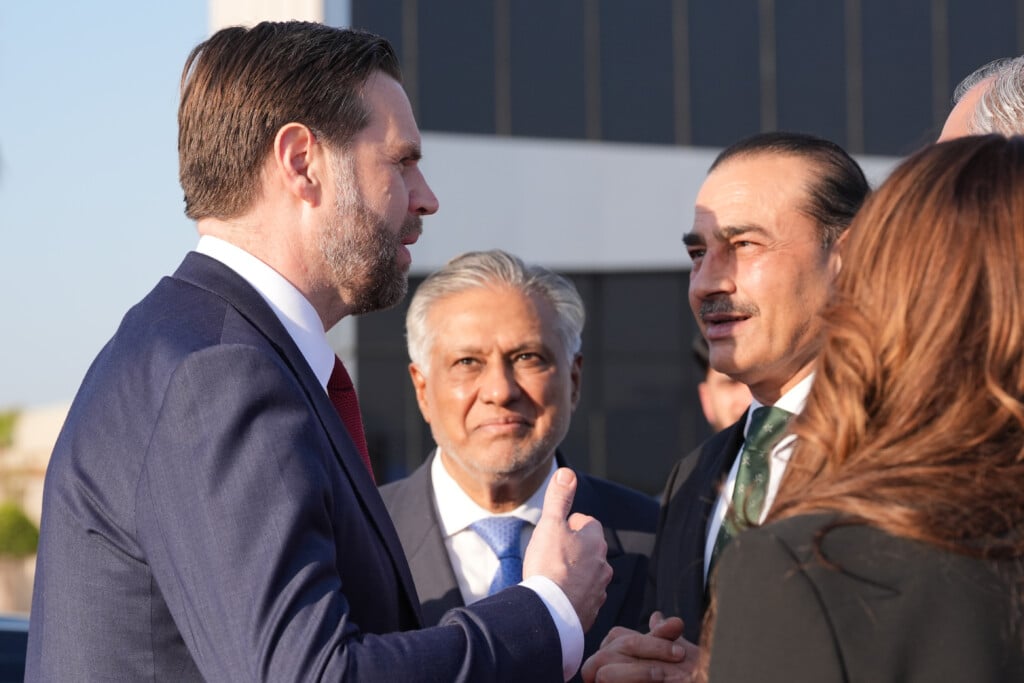
Vice President JD Vance, left, talks to Pakistan’s Chief of Defence Forces and Chief of Army Staff Field Marshall Asim Munir, right, and Pakistani Deputy Prime Minister and Foreign Minister Mohammad Ishaq Dar, center, before boarding Air Force Two after attending talks on Iran in Islamabad, Pakistan, Sunday, April 12, 2026. (AP Photo/Jacquelyn Martin, Pool)
FULL STORY:
U.S. President Donald Trump said Sunday the U.S. Navy will “immediately” begin a blockade to stop ships from entering or leaving the Strait of Hormuz, after U.S.-Iran peace talks in Pakistan ended without an agreement.
Iran has demanded the right to collect tolls from vessels traveling through the strait, but Trump said no one who pays them will “have safe passage on the high seas.”
Earlier in the day, the United States and Iran ended 21 hours of face-to-face talks in Islamabad without reaching a deal, leaving the fate of the fragile, two-week ceasefire still unclear.
“The simple fact is that we need to see an affirmative commitment that they will not seek a nuclear weapon, and they will not seek the tools that would enable them to quickly achieve a nuclear weapon,” Vice President JD Vance told reporters.
The war that has killed thousands of people and shaken global markets has entered its seventh week.
The U.S. delegation led by Vance and the Iranian delegation led by parliament Speaker Mohammad Bagher Qalibaf had discussed how to advance a ceasefire already threatened by deep disagreements and Israel’s continued attacks against the Iran-backed Hezbollah in Lebanon.
Here is the latest:
Middle East security expert says Trump has little leverage in the Strait of Hormuz
Andreas Krieg, a senior lecturer in security studies at Kings College London, said Sunday that Trump’s plan to use the U.S. Navy to block the Strait of Hormuz is unrealistic.
“We should bear in mind that the Americans have a much lower threshold of pain than the Iranians,” Krieg said. “The Iranians, whatever happens, can sustain this for far longer than the world economy, far longer the Gulf states, far longer then the Americans.”
Krieg said Trump doesn’t have “any good options” and that he will have to concede on some issues.
“There isn’t any tool in the toolbox in terms of the military lever that he could use to get his way,” he said.
Energy expert says oil price could jump by $10 on Trump’s threatened blockade of the Strait of Hormuz
Brent crude oil, the international standard, has gone from roughly $70 per barrel before the war in late February to more than $119 at times. Brent for June delivery fell 0.8% to $95.20 per barrel Friday.
Michael Lynch, distinguished fellow at Energy Policy Research Foundation, estimates Trump’s threatened blockade could boost oil prices $5 to $10 when the market opens on Monday.
The blockade would take an estimated 2 million barrels of oil per day off the market, and the Iran war has already taken roughly 10 million barrels per day out of supply, Lynch said.
“This is a pretty big insult to a pretty big injury, I guess, is the way to put it,” he said.
But Lynch said the blockade might be short lived as Trump will be pressured to walk it back.
“I wouldn’t be surprised to see him to give it up by midweek, especially if oil prices keep going up,” he said.
Iran’s chief negotiator says Trump’s threats ‘have no effect on Iranian people’
Parliament Speaker Mohammad Bagher Qalibaf told reporters Sunday that Iran has shown it doesn’t surrender to threats, hours after Trump said the U.S. would impose a blockade to stop ships from entering or leaving the Strait of Hormuz.
“If you fight, we will fight.” Qalibaf said in a social media post addressing Trump.
Qalibaf said the talks in Pakistan were “intensive, serious and challenging,” and that Iran’s negotiators “designed strong initiatives to demonstrate Iran’s goodwill, which led to progress.”
He did not describe the progress made during the talks nor Iran’s strong initiatives.
Lebanon’s prime minister says his government is committed to ending the war through negotiations
Nawaf Salam made his remarks on the eve of the 51st anniversary of the start of Lebanon’s 15-year civil war.
Lebanon and Israel will hold direct talks in Washington starting Tuesday in a bid to end Israel’s conflict with Hezbollah, an Iran-backed militant group in Lebanon.
Hezbollah supporters and critics of the decision to negotiate have protested in Beirut, saying the government is too weak to end the war.
The government has set a truce as a prerequisite for talks, and plans to demand an Israeli withdrawal, the release of Lebanese prisoners, and the return of over one million displaced Lebanese.
Lebanese authorities have criticized Israel’s airstrikes and ground invasion, but have also decried Hezbollah for launching rockets on March 2nd in solidarity with Iran, sparking the latest escalation.
The Lebanese government came to power just over a year ago promising to disarm all non-state groups.
“I feel the pain of the mother who lost her son combatting on the frontlines as I feel the pain of the mother who lost her child who did not choose this war and only wanted to live,” said Salam.
Experts say blockade could lead to higher oil prices but more details are needed on implementation
Kevin Book, the managing director of research at research firm ClearView Energy Partners, said Sunday that leaner volumes generally mean tighter markets and higher prices, but “much depends on the scope and implementation of the blockade.”
“How Tehran responds matters, too. Iranian and/or Houthi reprisals against Gulf producers’ alternative routes could drive prices still higher,” Book said.
Jonathan Elkind, senior research scholar at the Center on Global Energy Policy at Columbia University said Trump’s statement on Fox News that implementing the blockade will take some time also adds uncertainty.
“Is this a climb down because of concerns about how sharply oil markets were set to rise in tomorrow’s trading? No one knows,” he said.
US official says Iran could not agree to America’s red lines for ending the war
U.S. Vice President JD Vance’s goal in the talks with Iran was to outline America’s red lines and where there was room to negotiate. But Iran’s delegates could not agree to all of the stated red lines.
That’s according to a U.S. official who spoke to The Associated Press on condition of anonymity because they were not authorized to describe negotiating positions on the record.
The core objective for U.S. negotiators was that Iran never obtain a nuclear weapon. But there were additional red lines set by the U.S. that Iran objected to, the official said.
The red lines include Iran ending uranium enrichment, dismantling its major enrichment facilities, allowing retrieval of its highly enriched uranium, ending funding for Hamas, Hezbollah and the Houthis, creating a broader framework for peace and security in the region, and opening the Strait of Hormuz.
The U.S. believes that blockading the strait will show Iran the limits of its leverage as it considers the offer, the official said.
By Josh Boak
Netanyahu visits parts of southern Lebanon under Israeli military control
Israel’s prime minister was making his first visit since the start of the current round of fighting between Israel and Hezbollah.
“One of the things we see here is that we have essentially changed the face of the Middle East,” Netanyahu said Sunday. “Our enemies — Iran and the Axis of Evil — they came to destroy us, and now they are simply fighting for their own survival.”
Netanyahu said Saturday that Israel was working to control an 8 to 10 km (5 to 6 mile) buffer zone inside Lebanon to ensure Hezbollah does not fire close-range rockets and anti-tank missiles over the border.
Iran says it has ‘full control’ of the Strait of Hormuz and that the waterway remains open for non-military vessels
Iran’s Revolutionary Guard Navy said Sunday that military vessels approaching the Strait of Hormuz “will be met with a firm and forceful response,” according to two semi-official Iranian news agencies.
Earlier Sunday, Trump said the U.S. Navy would begin a blockade on the critical waterway to stop ships from entering or leaving.
The talks in Pakistan between Iran and the U.S. ended Sunday without an agreement to end the fighting.
UN peacekeeping mission in southern Lebanon says Israeli tanks rammed into their vehicles
The mission, known as UNIFIL, said Israeli ground troops twice rammed their vehicles with a Merkava tank on Sunday.
The soldiers were blocking a road in Bayada that peacekeepers have been using to access their positions, UNIFIL said in a statement.
UNIFIL has decried attacks on its personnel and damage to its facilities since
the latest war between Israel and Hezbollah militants started on March 2. Three peacekeepers have been killed in the past month.
“Israeli soldiers have continually blocked peacekeepers’ movements on this road in recent days, in addition to denials of freedom of movement recorded in other areas,” UNIFIL said. “They hinder peacekeepers’ ability to report violations by both sides on the ground.”
Trump says the UK is sending minesweepers to the Strait of Hormuz
Britain’s Defense Ministry did not immediately respond to a message seeking comment about Trump’s assertion Sunday on Fox News.
In an April 2 meeting of top diplomats from 40 nations, British Foreign Secretary Yvette Cooper discussed mustering their collective powers to remove mines from strait once the conflict diminished.
Cooper convened a meeting with about 30 of those nations last week to discuss restoring free movement in the shipping channel and a follow-up is scheduled this week.
In March, James Cartlidge, the opposition Conservative Party’s defense secretary, said the British Navy removed its last minesweeper from the Persian Gulf a week before the war began.
Saudi Arabia summons Iraqi ambassador over drone attacks
Saudi Arabia’s Foreign Ministry submitted a “protest note” Sunday to the Iraqi ambassador following what it called ongoing drone attacks launched from Iraqi territories against Saudi Arabia and neighboring Gulf States.
It was not immediately clear if the Iraqi drone attacks are still taking place.
The Islamic Resistance in Iraq, an umbrella group of Iran-backed Iraqi militias, said last week that it would halt its operations in Iraq and the region for two weeks, hours after the U.S. and Iran agreed to a two-week ceasefire.
Iran-backed militias in Iraq have claimed responsibility for dozens of attacks on U.S. bases and other facilities in the country in solidarity with Tehran since the war began.
Iran’s president says his country is prepared to reach ‘balanced and fair’ agreement
President Masoud Pezeshkian told Russian President Vladimir Putin on Sunday that his country is prepared to reach a deal that would ensure “lasting regional peace.”
Pezeshkian added that Iran’s national interests are a red line, according to a readout of the call carried by Iran’s state-media.
He criticized the U.S. use of bases in Gulf countries to carry out strikes against Iran, while maintaining that Gulf countries are “brothers” and that Tehran is willing to cooperate with them to achieve regional security “without outside powers”
Iran has said it has repeatedly struck U.S. facilities in neighboring Gulf countries since the war started in late February. Gulf countries say Iran has also targeted civilian infrastructure and facilities.
Egypt’s foreign minister speaks with a senior Pakistani diplomat and a US envoy
In the call with U.S. envoy Steve Witkoff, Foreign Minister Badr Abdelatty affirmed “the importance of adhering to the diplomatic path and prioritizing dialogue and peaceful solutions” to settle all disputes.
Abdelatty and his Pakistani counterpart, Mohammad Ishaq Dar, affirmed that they will continue their efforts to de-escalate and bridge the gaps between the U.S. and Iran.
Pakistan, Egypt and Turkey have been mediating between the U.S. and Iran since the start of the war.
Iran war has cost Israel at least $11.5 billion, Finance Ministry says
Israel’s Ministry of Finance released its initial estimate of the cost of the Iran war on Sunday.
Some NIS 22 billion ($7.25 billion) has been spent on defense and military costs, including equipment and mobilizing more than 100,000 reserve soldiers, the ministry said.
Another NIS 12 billion ($4 billion) accounts for damages incurred by businesses and individuals from missiles or other related war losses, including missed days of work.
The ministry noted that some of the costs — including economic losses stemming from the war’s 40-day closure of the airports and many businesses — will only become apparent in the future.
At the height of its war with Gaza, Israel spent an estimated NIS 14 billion ($4.7 billion) per month on its military, more than double its monthly budget before the Oct. 7, 2023, attack.
2,055 people in Lebanon have been killed in Israeli strikes since the start of the latest war between Israel and Hezbollah
Among the dead are 252 women, 165 children, and 87 medical workers, Lebanon’s Health Ministry said in its daily casualty count.
6,588 others have been wounded.
Trump doubts China is providing ‘shoulder missiles’ to Iran, but he would tariff Chinese goods if they did
The U.S. president said his threat to impose 50% tariffs on goods from countries that sold weapons to Iran was aimed at China.
Trump told Fox News’ “Sunday Morning Futures” that has heard reports of China giving anti-aircraft “shoulder missiles” to Iran. He played down the possibility of China supplying weapons to Iran, but said their goods would be taxed if they did.
“I doubt they would do that, because I have a relationship, and I think they wouldn’t do that, but maybe they did a little bit at the beginning,” Trump said. “But if we catch them doing that, they get a 50% tariff.”
Copyright 2026 The Associated Press. All rights reserved.
For more U.S. news stories, click here.